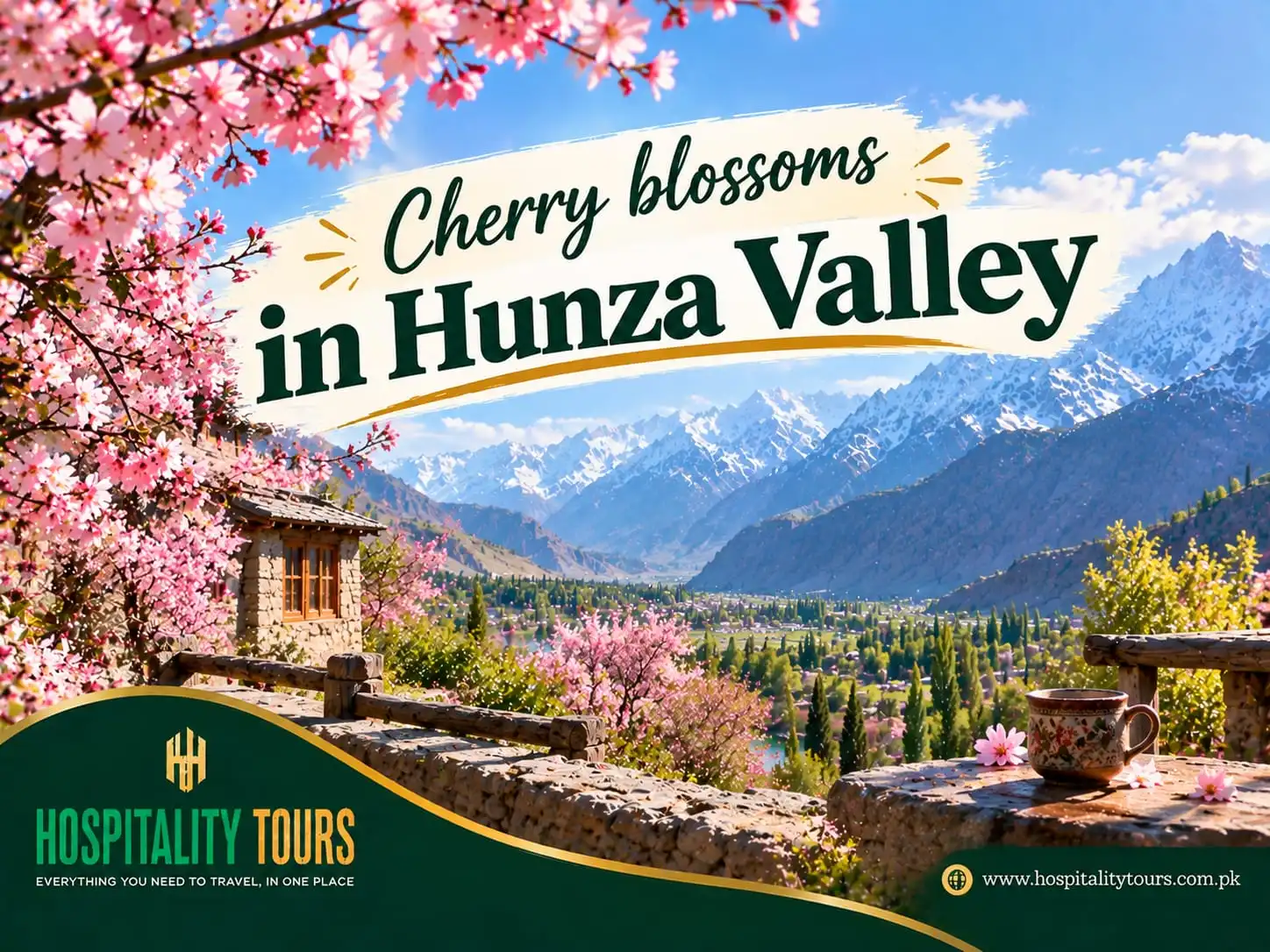
Cherry blossoms in Hunza Valley
Blossom season in Hunza is largely dependent on the elevation. Blossoms come earlier at lower elevations and later at higher elevations. Thus, blossoms come first in Lower Hunza, slightly later in Karimabad and Altit, and sometimes later in Gulmit and Passu. Plus, somewhat of a delay in the upper villages.
One important note before planning a trip: most of what people call and take pictures of as cherry blossoms in Hunza is actually apricot. The Valley itself is an apricot economy. Apricots are the main profitable cash crop and dominate the other fruit trees. Almond, peach, plum, apple, and pear trees are present, but real cherry trees are sparse. It should be noted that the beauty of the blooms should not be discounted. Knowing and understanding the trees you photograph will definitely enhance your trip.
What the blossoms symbolize
In most places, a blossom season is decorative; in Hunza, it is the closure of winter and the start of the working year.
The same trees that flower in March are the trees that are harvested in July. Then the fruit is used fresh, or preserved by drying or pressing the fruit to collect the oil. The apricot kernels are even used. Orchards in Hunza have been the sole financial sustenance for families living in the Valley, which receives hardly any rainfall and is barren without irrigation and fruit plantations.
Standing under a farmer's tree in April means you’re standing in that income for the year. Always ask for his permission before entering the orchard. For that photo, don't be the person who pulls the branch down and causes the tree to lose blossoms.
The timing and why nobody can give you a date
From a farmer’s perspective, elevation dictates the length of the blooming season in Hunza. One town would not get a long enough period to yield a harvest.
In Lower Hunza, the farms are approximately 2,000 meters above sea level. Here, the season starts around the second half of March.
In Central Hunza, in the villages of Karimabad, Altit, Ganish and Aliabad, the season peaks around the last week of March and starts moving into the first week of April.
Farther up in the Valley and into colder regions of Hunza, which is Upper Hunza, peak season in the villages of Gulmit, Ghulkin and Passu usually starts around the first week of April or even towards the end of the month.
Whenever you are in the Hunza Valley, peak season stays for roughly a month or a month and a half. In a single village, peak season is usually for less than two weeks.
Based on the village’s elevation and the variability of the year’s temperatures, peak season in Hunza shifts. A colder February brings peak season later, as does an earlier cold snap. The worst possible thing is to have a late cold snap because the blossoms can drop as a result. If someone is selling you a fixed-date promise for peak season, they are guessing. The actual promise they are selling is having a flexible plan to go where the blossoms are in the Valley.
Where to see it
If you're looking to see it in person, head to Karimabad or the surrounding terraces. This location offers the iconic view of the stacked orchards with Rakaposhi in the background. Additionally, consider walking through the lanes that connect Karimabad and Altit instead of taking the main road, as much of the main road lacks proper access.
The Royal Garden below Altit Fort. Amazing old ruins, new gardens, and flowering apricot trees. It's easily one of the best spots to see.
Ganish and the lower villages. Ganish, Khanabad, Hassanabad and Aliabad will be the first to have blossoms, so if you get here on the earlier side of the season, this is the place you want to be.
Duikar and Eagle's Nest. Probably the best view in Hunza; you look over the Valley and see blossoms all the way.
Rakaposhi View Point at Ghulmet. Take the highway to get to Karimabad, and about 45 minutes before you get there, you'll pass through some orchards in front of Rakaposhi that are under a 7,788-meter wall of ice.
Nagar and Hoper. You'll see blossoms across the river, amongst glacier ice and moraine, which is a cool juxtaposition.
Attabad Lake. In the summer, it has flowers along the shore and is a beautiful turquoise color.
Gulmit and Passu. Blossom at the last act of the season. Ondra Poygah's staircase is a cool way to see it. Passu Cones are your backdrop here.
Skardu, Shigar, and Khaplu have flowers after Hunza, so that can be your last stop for the season in case you still want more.
Actual weather conditions
As for the temperatures during the blossom season, any place you stay will experience highs ranging anywhere between 10 and 20 and lows around 32 °F during nights in lower villages, and cellar-freezing or below in upper villages. You can expect to get snow showers and rain during the earlier weeks.
Due to the low snowline, the pictures you will be able to click will have flowers in the foreground and winter scenes behind them.
Don't forget to take layers, a good waterproof jacket, rain shoe covers, and comfortable boots as you will be walking in orchards, dirt paths, and possibly even muddy paths. Although some hotels may have heating systems, it is better to check before you reach there, since not every hotel turns its heating system on until the season kicks in.
Other Optional Activities
Forts at Baltit and Altit are open during this season.
Boat services on Attabad Lake are available, but visitors should be prepared for the cold weather, as the lake operators are open during the summer months only.
Fit hikers can reach the meadows of Ultar from Karimabad, and shorter walks to Borith are safe.
Khunjerab Pass remains closed during the earlier part of the season. Complete this pass for a visit to northern areas in April.
From Islamabad, Babusar Pass is closed, so plan on the entire Karakoram Highway route from Besham to Chilas.
Deosai and side roads to Shimshal and Chapursan are best avoided during this season.
Photography without spoiling it for the rest
Light is best in the hours surrounding sunrise and sunset, with the middle of the day losing all dimension to everything.
Rather than taking photos from the highway, shoot from lanes and terraces and go as high above the orchards as you can. Duikar and the paths above Altit provide a perspective that can't be achieved from a Highway shot.
Drone regulations in Pakistan are complicated, and this is a border region, so do not assume you can fly. Rather, look into what the most up-to-date drone regulations and permissions are before you travel.
It is important to ask before taking photos. This goes for both taking photos of people and women and entering private land (which is most of the orchards you would like to take photos in).
A five-day itinerary that works
Day one, either fly or drive to Gilgit and continue to Karimabad.
Day two, hike to the central Hunza orchards. Explore Baltit, Altit, and the Royal Garden. Photograph from the lanes that connect the villages. Capture sunset from a higher perspective on one of the paths above the village.
Day three: wake up for sunrise at Duikar, then take the road down to Ganish, then Rakaposhi View Point, and across to Nagar, all depending on the location of the blossom for the week.
Day four, the road leads north to Attabad, Gulmit and Passu. This is where the later blossom will be for the week, with a driving stop for the night at Gojal for first light in the upper Valley.
Day five: back to Gilgit to take the flight, or the first stretch of the drive south.
Add four days to your schedule if you want to visit Skardu at the end of the season, plus one more if you're driving both ways.
What to check and what to avoid
Instead of asking when the season begins, ask where the blossoms are. If your operator answers with a list of villages and elevations from the current week, that's a good answer.
What does the operator say if the blossoms bloom early or late? The right answer is flexibility to change elevations by moving up or down the Valley.
Call ahead to the hotels. Ask if the heating is operational in March, even if the hotel says they are open.
Book as far in advance as possible. The last week of March and the first two weeks of April are the busiest times in Karimabad during spring. The better rooms fill up this far in advance.
Have a fallback plan if you're flying. Spring clouds cause Gilgit to cancel flights regularly, and a two-day, unplanned drive will be a surprise.
A single-day plan to visit a single village is not a good idea. Blossom is a moving target, and the whole idea is mobility.
Do not go into orchards without permission, do not break branches, and do not climb for photos.
Avoid booking through Facebook pages that require an advance payment and cannot provide a license number or office address. This is a spring problem in this Valley every year.
So you have a few questions. Let’s see if I can answer them.
When is the best time to visit to see the blossoms in Hunza? March to April should be good, up the Valley each month by around 20- 30 km. Lower Hunza will see them in late March; Karimabad and Altit in early April; Passu and Gulmit will be beginning to see them towards the end of April.
Are they really cherry blossoms? There are some cherry trees, but most of the trees are other fruit trees like peach, apricot, almond, plum, and apple. The whole Valley advertises this as cherry blossoms.
How long do they last? About 2 weeks per village and up to 6 weeks across the whole Valley.
Where should I visit to see the most blossoms? Drive up to Karimabad, visit the Royal Garden, or stay at Duikar (for the view). For a spectacular view of blossoms with snow-capped peaks, visit Nagar or Ghulmet.
What is the best weather to expect? Expect lows of 0 to 10 degrees, highs of 10 to 20 degrees. Be prepared for rain or snow. Especially in March, when it is possible that Khunjerab Pass may be closed.
Is Skardu a good place to go for blossoms? Yes, especially if you visit after Hunza Valley.
Do we need to take a flight to Gilgit to see blossoms in Hunza? No, you don’t have to take a flight. Take the road instead. Spring comes to Gilgit first, before the weather clears. Plan to travel by road instead of flying, and visit Skardu for blossoms.
How far ahead should I look? Around 2-3 months for peak season in central Hunza. The best rooms and good guides get reserved first.
Let us track the bloom for you.
We plan blossom trips with the timing built in rather than assumed. We know which villages are flowering in the week you are traveling, and we build the route so you move to the blossom rather than hoping it waits for you. Booked hotels in the right part of the Valley, transport with drivers who know the lanes worth walking, and a licensed guide who can get you access to an orchard as a guest rather than a trespasser.
Let us know your dates and how many of you will be traveling, and we will give you our honest expectations of what those dates will provide before anything is booked.
WhatsApp +92 341 111 3777
Head office: Office No. 2 & 3, Ground Floor, Parish Rose Plaza, Opposite NUST Gate 4, Sector H-13, Islamabad